
Common Study Myths Debunked by Learning Science
Discover the truth behind popular study beliefs. Learn which common study methods are actually counterproductive and what science reveals about effective learning strategies.
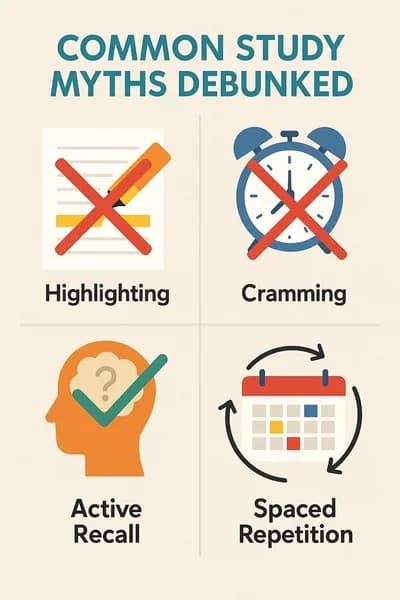
Common Study Myths Debunked by Learning Science
Many of the study techniques students swear by are actually counterproductive.
For decades, popular study advice has been passed down through generations of students, teachers, and parents. But when researchers put these methods to scientific testing, the results are often shocking: many widely believed study strategies not only fail to improve learning but can actually harm academic performance.
The gap between what people believe works and what science proves works is enormous. This comprehensive guide separates fact from fiction, revealing which study methods are myths and providing evidence-based alternatives that actually enhance learning.
What you'll discover:
- The most persistent study myths and why they persist
- Scientific evidence that debunks popular study beliefs
- The psychological reasons behind these misconceptions
- Evidence-based alternatives to ineffective study methods
- How to evaluate study advice using scientific criteria
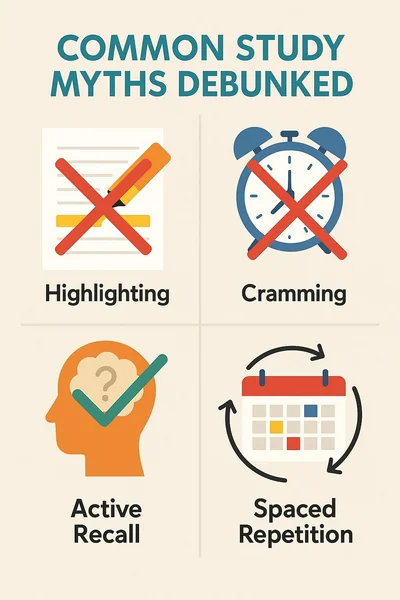
The Science of Study Myth-Busting
Why Study Myths Persist
Despite overwhelming scientific evidence, study myths continue to dominate educational practices. Understanding why helps us avoid these traps.
Psychological Factors:
Illusion of Knowing:
- Familiarity bias: Rereading creates false sense of mastery
- Recognition vs. recall: Knowing you've seen information before feels like understanding
- Confidence inflation: Passive review increases confidence but not competence
- Fluency misconception: Easy processing during review misleads about learning
Effort Justification:
- Hard work fallacy: Assumption that more time equals better learning
- Visible activity: Highlighting and note-taking feel productive
- Immediate gratification: Some methods provide instant satisfaction but poor long-term results
- Social validation: Popular methods seem credible because "everyone does it"
Educational Perpetuation:
Institutional Inertia:
- Traditional practices: Schools continue methods used for generations
- Teacher training gaps: Many educators lack training in learning science
- Standardized testing: Assessment methods may reinforce ineffective study habits
- Resource constraints: Effective methods may require different materials or approaches
Cultural Transmission:
- Parental influence: Parents teach methods they learned, even if ineffective
- Peer modeling: Students copy what they see others doing
- Authority figures: Teachers and tutors may unknowingly perpetuate myths
- Media reinforcement: Popular culture often depicts ineffective study methods
The Research Revolution
Modern learning science has systematically tested study methods and revealed surprising truths:
Methodology Advances:
- Controlled experiments: Comparing methods under identical conditions
- Longitudinal studies: Tracking learning outcomes over months and years
- Brain imaging: Understanding neural mechanisms of learning
- Meta-analyses: Combining results from hundreds of studies
Key Findings:
- Active vs. passive: Active methods consistently outperform passive review
- Difficulty benefits: More challenging study methods often produce better results
- Testing effects: Retrieval practice beats repeated reading by large margins
- Spacing benefits: Distributed practice dramatically outperforms massed practice
Major Study Myths Debunked
Myth 1: "Highlighting and Underlining Improve Learning"
The Belief:
Marking important information helps you remember it better and makes review more efficient.
The Science:
Research verdict: Largely ineffective and potentially harmful
Evidence Against Highlighting:
Dunlosky et al. (2013) Review:
- Effectiveness rating: Low
- Key finding: Highlighting shows minimal benefit for comprehension or retention
- Problem identified: Students often highlight too much or highlight unimportant information
- Alternative recommendation: Use summarization and self-testing instead
Specific Studies:
- Peterson (1992): Students who highlighted performed worse on tests than those who didn't
- Fowler & Barker (1974): Highlighting led to poorer performance on inference questions
- Silvers & Kreiner (1997): Pre-highlighted texts actually impaired learning
Why Highlighting Fails:
Cognitive Problems:
- Shallow processing: Highlighting requires minimal mental effort
- Attention splitting: Focusing on what to highlight reduces comprehension
- False confidence: Colorful pages create illusion of effective studying
- Poor selection: Students consistently highlight less important information
Meta-cognitive Issues:
- Overconfidence: Highlighted notes feel more familiar, inflating confidence
- Reduced elaboration: Highlighting replaces deeper thinking about content
- Passive engagement: Minimal active processing during highlighting
- Review inefficiency: Highlighted text still requires actual learning
Evidence-Based Alternatives:
Active Reading Strategies:
- Summarization: Write brief summaries in your own words
- Self-questioning: Generate questions about the material while reading
- Elaborative interrogation: Ask "why" and "how" questions about content
- Dual coding: Create visual representations of textual information
Myth 2: "Learning Styles Require Matched Teaching Methods"
The Belief:
Students learn best when instruction matches their preferred learning style (visual, auditory, kinesthetic, etc.).
The Science:
Research verdict: No scientific support despite widespread belief
Comprehensive Research Findings:
Pashler et al. (2009) Review:
- Studies examined: Over 100 learning styles studies
- Rigorous studies found: Less than 10 met scientific standards
- Conclusion: No evidence that matching instruction to learning styles improves outcomes
- Recommendation: Focus on content-appropriate methods rather than style preferences
Willingham et al. (2015) Analysis:
- Brain imaging evidence: No distinct neural pathways for different "learning styles"
- Cognitive architecture: All humans process information through the same basic mechanisms
- Individual differences: Exist in background knowledge and interests, not processing styles
- Educational implications: Content determines optimal teaching method, not student preferences
Why the Myth Persists:
Appeal Factors:
- Individual recognition: Makes students feel understood and special
- Simple explanation: Provides easy answer for learning difficulties
- Intuitive logic: Seems reasonable that people learn differently
- Commercial interests: Companies profit from learning style assessments and materials
Misinterpretation of Real Differences:
- Preferences vs. effectiveness: Students may prefer certain methods without learning better from them
- Background knowledge: Prior experience affects learning more than supposed styles
- Motivation: Engagement matters more than matching supposed preferences
- Content factors: Some subjects benefit from visual presentation, others from verbal
What Actually Matters:
Evidence-Based Individual Differences:
- Prior knowledge: What students already know dramatically affects new learning
- Working memory capacity: Individual differences in cognitive processing capacity
- Motivation and interest: Engagement levels significantly impact learning outcomes
- Metacognitive skills: Awareness of effective learning strategies
Content-Appropriate Methods:
- Spatial information: Maps and diagrams benefit from visual presentation
- Temporal sequences: Stories and processes benefit from verbal-sequential presentation
- Mathematical concepts: Often require multiple representations (visual, symbolic, verbal)
- Motor skills: Require kinesthetic practice regardless of student "style"
Myth 3: "Cramming Is Effective for Tests"
The Belief:
Intensive studying right before exams maximizes performance through concentrated effort.
The Science:
Research verdict: Extremely ineffective for long-term retention and often poor for immediate performance
Research Evidence:
Spacing Effect Studies:
- Ebbinghaus (1885): Original demonstration that spaced practice outperforms massed practice
- Cepeda et al. (2006): Meta-analysis of 317 studies confirming spacing superiority
- Rohrer & Taylor (2007): Spaced practice led to 2.5x better performance after one week
- Kornell (2009): Even students who prefer cramming perform better with spacing
Long-term Retention:
- 24 hours post-test: Crammed information forgotten 2-3x faster
- One week later: Spaced learners retain 60-80% vs. 20-30% for crammers
- Transfer tasks: Spaced practice leads to better application in new contexts
- Cumulative exams: Spaced learners maintain performance across multiple tests
Why Cramming Feels Effective:
Short-term Illusions:
- Immediate availability: Information feels accessible right after intensive study
- Fluency effects: Recent exposure creates false sense of mastery
- Test anxiety reduction: Intensive review reduces pre-test anxiety
- Social reinforcement: Cultural acceptance of cramming as normal
Cognitive Mechanisms:
- Working memory saturation: Intensive study overloads processing capacity
- Interference effects: New information interferes with previously learned material
- Fatigue factors: Mental exhaustion reduces encoding effectiveness
- Shallow processing: Time pressure prevents deep, meaningful learning
Evidence-Based Alternatives:
Distributed Practice:
- Spaced repetition: Review material at increasing intervals
- Daily review: Short, regular sessions rather than marathon cramming
- Interleaved practice: Mix different topics within study sessions
- Progressive difficulty: Gradually increase challenge over time
Strategic Test Preparation:
- Early start: Begin review process weeks before exams
- Active retrieval: Practice recalling information without notes
- Practice testing: Use practice exams under realistic conditions
- Sleep optimization: Ensure adequate rest for memory consolidation
Myth 4: "Multitasking Improves Efficiency"
The Belief:
Studying while listening to music, checking social media, or watching TV makes study time more efficient and enjoyable.
The Science:
Research verdict: Multitasking significantly impairs learning and memory
Cognitive Research:
Attention Studies:
- Ophir et al. (2009): Heavy multitaskers showed worse performance on all cognitive measures
- Sana et al. (2013): Laptop use in lectures harmed both users and nearby students
- Pool et al. (2003): Background TV reduced reading comprehension by 19%
- Junco & Cotten (2012): Facebook use during studying correlated with lower GPAs
Brain Imaging Evidence:
- Task switching costs: Brain scans show significant delays when switching between tasks
- Attention networks: Multitasking reduces activation in learning-related brain regions
- Memory encoding: Divided attention impairs formation of long-term memories
- Cognitive control: Multitasking depletes mental resources needed for learning
The Myth of Multitasking:
What Really Happens:
- Task switching: Brain rapidly alternates between tasks, not simultaneous processing
- Switch costs: Each transition requires time and mental energy
- Attention residue: Previous tasks leave mental traces that interfere with current focus
- Quality degradation: Performance on all tasks suffers when attention is divided
Individual Differences:
- Age factors: Younger brains show less multitasking impairment but still suffer
- Practice effects: Heavy multitaskers become better at switching but still perform worse
- Task types: Simple, automatic tasks less affected than complex learning
- Overconfidence: People consistently overestimate their multitasking abilities
Evidence-Based Focus Strategies:
Single-Tasking:
- Full attention: Dedicate complete focus to one learning task at a time
- Environmental control: Remove distractions from study environment
- Time blocking: Allocate specific time periods for different activities
- Mindful awareness: Notice when attention wanders and gently redirect
Strategic Breaks:
- Pomodoro Technique: 25 minutes focused work, 5 minute break
- Activity switching: Change between different types of learning tasks
- Restorative breaks: Nature walks, meditation, or light exercise
- Social interaction: Brief conversations between study sessions
Myth 5: "Some People Are Just Bad at Math/Science/Languages"
The Belief:
Academic ability in specific subjects is fixed and determined by natural talent or genetics.
The Science:
Research verdict: Academic abilities are highly malleable and responsive to effective instruction and practice
Growth Mindset Research:
Dweck et al. Studies:
- Intervention effects: Students taught about brain plasticity improved grades significantly
- Effort attribution: Focusing on effort rather than ability increased persistence
- Challenge seeking: Growth mindset students chose more difficult problems
- Recovery patterns: Better bounce-back from failures and setbacks
Neuroplasticity Evidence:
- Brain imaging: Learning creates physical changes in brain structure
- Adult learning: Even elderly brains show remarkable plasticity
- Skill acquisition: Deliberate practice can lead to expert-level performance
- Recovery studies: Brain damage patients can relearn lost abilities
Subject-Specific Debunking:
Mathematics Anxiety:
- Cultural factors: Countries with positive math attitudes show higher achievement
- Teaching methods: Inquiry-based instruction reduces math anxiety
- Practice effects: Systematic practice improves mathematical intuition
- Gender myths: Differences in math performance largely due to societal factors
Language Learning:
- Critical period myth: Adults can achieve native-like proficiency with proper methods
- Individual variation: Success depends more on method and motivation than age
- Polyglot evidence: Many people successfully learn multiple languages as adults
- Immersion effects: Proper exposure can overcome supposed language limitations
Evidence-Based Ability Development:
Effective Practice Principles:
- Deliberate practice: Focused work on specific weaknesses
- Progressive challenge: Gradually increasing difficulty levels
- Expert feedback: Guidance from knowledgeable instructors
- Persistence training: Building resilience through managed challenges
Environmental Factors:
- Quality instruction: Effective teaching methods matter more than innate ability
- Peer support: Collaborative learning environments boost achievement
- Resource access: Equal access to materials and opportunities
- Cultural expectations: High expectations lead to higher achievement
Myth 6: "More Study Time Equals Better Grades"
The Belief:
Academic success is primarily determined by the amount of time spent studying.
The Science:
Research verdict: Study quality matters far more than quantity; ineffective methods can make more time counterproductive
Time vs. Quality Research:
Efficiency Studies:
- Plant et al. (2005): Students using effective methods achieved better results in 50% less time
- Kornell & Bjork (2007): Difficult, high-effort methods led to better learning despite feeling less effective
- McDaniel et al. (2009): Active retrieval methods dramatically outperformed additional reading time
- Rohrer & Pashler (2007): Spacing effects were more important than total practice time
Diminishing Returns:
- Cognitive fatigue: Extended study sessions show rapidly declining effectiveness
- Interference effects: Too much study can create confusion and impair memory
- Motivation decay: Excessive study time reduces engagement and enjoyment
- Sleep trade-offs: Studying instead of sleeping often reduces overall performance
What Matters More Than Time:
Study Method Quality:
- Active vs. passive: Retrieval practice beats re-reading regardless of time spent
- Spaced vs. massed: Distributed practice outperforms cramming even with less total time
- Interleaved vs. blocked: Mixed practice leads to better transfer despite feeling more difficult
- Testing vs. reviewing: Self-testing is more effective than additional review time
Strategic Factors:
- Focus quality: Undivided attention makes time more productive
- Method matching: Using appropriate techniques for specific content types
- Energy management: Studying during peak alertness periods
- Goal alignment: Time spent on high-priority learning objectives
Evidence-Based Time Management:
Optimal Study Sessions:
- Duration: 25-50 minute focused sessions with breaks
- Frequency: Daily practice more effective than weekly marathons
- Timing: Align study periods with natural energy rhythms
- Recovery: Include rest and sleep as essential components
Efficiency Maximization:
- Technique selection: Choose methods proven effective for your content
- Progress monitoring: Track learning outcomes, not just time spent
- Elimination: Remove ineffective activities that consume time without benefit
- Automation: Build habits that reduce decision-making overhead
The Psychology of Study Myth Persistence
Cognitive Biases in Learning
Confirmation Bias:
- Selective attention: Noticing evidence that supports existing beliefs
- Interpretation skew: Explaining away contradictory evidence
- Source credibility: Trusting sources that confirm preferred methods
- Anecdotal evidence: Overweighting personal experience and stories
Availability Heuristic:
- Recent examples: Overestimating frequency of recently encountered events
- Vivid memories: Dramatic success stories seem more common than they are
- Media influence: Popular portrayals shape perception of typical study behavior
- Social proof: Assuming common practices must be effective
Sunk Cost Fallacy:
- Method investment: Continuing ineffective methods because of past time investment
- Identity protection: Changing methods feels like admitting previous mistakes
- Skill development: Having developed skill in ineffective methods creates reluctance to change
- Social commitment: Public advocacy for methods makes change more difficult
Social and Cultural Factors
Educational Traditions:
- Historical inertia: Continuing practices because "that's how it's always been done"
- Authority reverence: Trusting methods recommended by teachers and institutions
- Cultural transmission: Parents and peers passing on ineffective strategies
- Ritual significance: Study methods that feel important or ceremonial
Marketing and Commercial Interests:
- Product promotion: Companies selling highlighting supplies, learning style assessments
- Simplicity appeal: Easy solutions more marketable than complex, evidence-based methods
- Quick fixes: Promise of rapid improvement through simple changes
- Expert endorsement: Testimonials from successful people using ineffective methods
How to Evaluate Study Advice Scientifically
Research Quality Indicators
Study Design Features:
- Controlled experiments: Comparing methods while controlling other variables
- Random assignment: Participants randomly assigned to different conditions
- Blind evaluation: Assessors unaware of which methods participants used
- Appropriate controls: Comparison groups that isolate the effects of specific methods
Evidence Strength:
- Sample size: Larger studies provide more reliable results
- Replication: Findings confirmed by multiple independent studies
- Meta-analyses: Systematic combination of results from many studies
- Long-term follow-up: Studies that track outcomes over months or years
Practical Relevance:
- Ecological validity: Studies conducted in realistic educational settings
- Diverse populations: Results that generalize across different student groups
- Effect sizes: Magnitude of improvements, not just statistical significance
- Cost-benefit analysis: Considering time and effort required for benefits achieved
Red Flags in Study Advice
Warning Signs:
- Absolute claims: Statements that something "always works" or "never works"
- Anecdotal evidence: Relying primarily on personal stories and testimonials
- One-size-fits-all: Methods claimed to work for everyone in every situation
- Quick fixes: Promises of dramatic improvement with minimal effort
Source Evaluation:
- Credentials: Does the source have relevant expertise in learning science?
- Conflicts of interest: Does the source profit from recommending certain methods?
- Citation quality: Are claims supported by peer-reviewed research?
- Balanced perspective: Does the source acknowledge limitations and alternative views?
Building an Evidence-Based Study System
Principles for Method Selection
Scientific Foundation:
- Research support: Choose methods backed by multiple high-quality studies
- Mechanism understanding: Prefer methods with clear explanations of why they work
- Comparative effectiveness: Select techniques proven superior to alternatives
- Replication evidence: Trust methods confirmed by independent researchers
Personal Adaptation:
- Content matching: Use methods appropriate for your specific subjects
- Schedule integration: Choose techniques that fit your available time and energy
- Learning goals: Align methods with whether you need retention, understanding, or application
- Progress monitoring: Track outcomes to verify methods work for you personally
Implementation Strategy
Gradual Transition:
- One change at a time: Replace ineffective methods gradually rather than all at once
- Pilot testing: Try new methods on low-stakes material first
- Patience with adjustment: Allow time to develop skill with new techniques
- Outcome tracking: Monitor both immediate experience and long-term results
Habit Formation:
- Environmental design: Set up physical and digital environments to support effective methods
- Cue identification: Create specific triggers for evidence-based study behaviors
- Social support: Find others committed to using effective study methods
- Regular evaluation: Periodically assess and adjust your study system
The Future of Learning Science
Emerging Research Areas
Neuroscience Integration:
- Brain imaging: Understanding neural mechanisms of effective learning
- Individual differences: Identifying biological factors that influence learning
- Optimization: Using brain data to refine learning techniques
- Technology development: Creating tools that leverage neuroscience insights
Artificial Intelligence:
- Personalized learning: AI systems that adapt to individual learning patterns
- Predictive analytics: Identifying which students will benefit from which methods
- Automated assessment: AI that evaluates learning progress and suggests adjustments
- Content optimization: AI-generated materials designed for maximum learning effectiveness
Educational Transformation
Institutional Change:
- Teacher training: Educating instructors about learning science research
- Curriculum revision: Updating educational programs to reflect effective methods
- Assessment reform: Changing testing practices to support evidence-based learning
- Policy development: Creating guidelines based on research rather than tradition
Cultural Shift:
- Public awareness: Increasing understanding of learning science among students and parents
- Myth correction: Systematically addressing widespread misconceptions
- Evidence emphasis: Promoting research-based decision making in education
- Continuous improvement: Building cultures that adapt based on new scientific evidence
Conclusion: Embracing Evidence-Based Learning
The gap between popular study beliefs and scientific evidence is not just an academic curiosity - it represents a massive opportunity for improvement in educational outcomes.
Students who embrace evidence-based learning methods can achieve dramatically better results with less effort and stress. But this requires the courage to abandon comfortable myths in favor of sometimes counterintuitive scientific truths.
Key Principles for Evidence-Based Learning:
- Question everything: Don't assume popular methods are effective just because they're common
- Seek evidence: Look for research support before adopting study techniques
- Embrace difficulty: Methods that feel challenging often produce better learning
- Focus on outcomes: Judge techniques by results, not by how they feel during practice
- Stay curious: Remain open to new evidence and willing to change methods
- Think long-term: Prioritize techniques that build lasting knowledge and skills
Your Evidence-Based Learning Journey:
- Audit current methods: Honestly evaluate which techniques you currently use
- Research alternatives: Find evidence-based replacements for ineffective methods
- Start small: Implement one or two changes at a time
- Monitor progress: Track both learning outcomes and personal experience
- Adjust based on evidence: Modify your approach based on what works for you
- Share knowledge: Help others discover evidence-based learning methods
Remember: The goal isn't to make studying harder, but to make it more effective. Many evidence-based methods actually reduce the total time and effort required for learning while producing superior results.
The students who will thrive in the future are those who learn to distinguish between what feels good and what actually works. By embracing learning science and abandoning study myths, you're not just improving your academic performance - you're developing critical thinking skills that will serve you throughout your life.
Every myth you abandon and every evidence-based technique you adopt moves you closer to your full learning potential. The research is clear, the methods are available, and the benefits are proven. The only question is whether you're ready to embrace the science of learning.
Ready to abandon study myths and embrace evidence-based learning? Start by identifying one ineffective method you currently use and replacing it with a research-supported alternative. Small changes in study methods create dramatic improvements in learning outcomes.
Want guidance in building your evidence-based study system? Consider working with learning specialists who understand educational research and can help you implement scientifically proven methods effectively.
Important Note: Learning science is an evolving field, and new research continues to refine our understanding of effective study methods. Always evaluate study advice critically and be willing to adjust your methods as new evidence emerges. Individual differences mean that while research provides general principles, you may need to adapt methods to your specific situation and goals.
Related Articles

The Science of Holiday Learning: How Rest Periods Actually Boost Memory and Academic Performance
Discover why strategic learning during holidays is more effective than cramming. Evidence-based insights on how rest periods enhance memory consolidation and long-term retention.

How to Learn German from Scratch: A Realistic A1 to B2 Plan
German has a reputation for being hard — mostly the articles, the cases, and the word order. But it is a logical, orderly language, and German and English are close cousins. With a plan, it is very learnable. Here is the whole road.

How to Learn French from Scratch: A Realistic A1 to B2 Plan
French shares thousands of words with English, so reading comes quickly — the real challenge is the gap between spelling and sound. Tame that, and the rest falls into place. Here is the whole road from zero to fluency.